
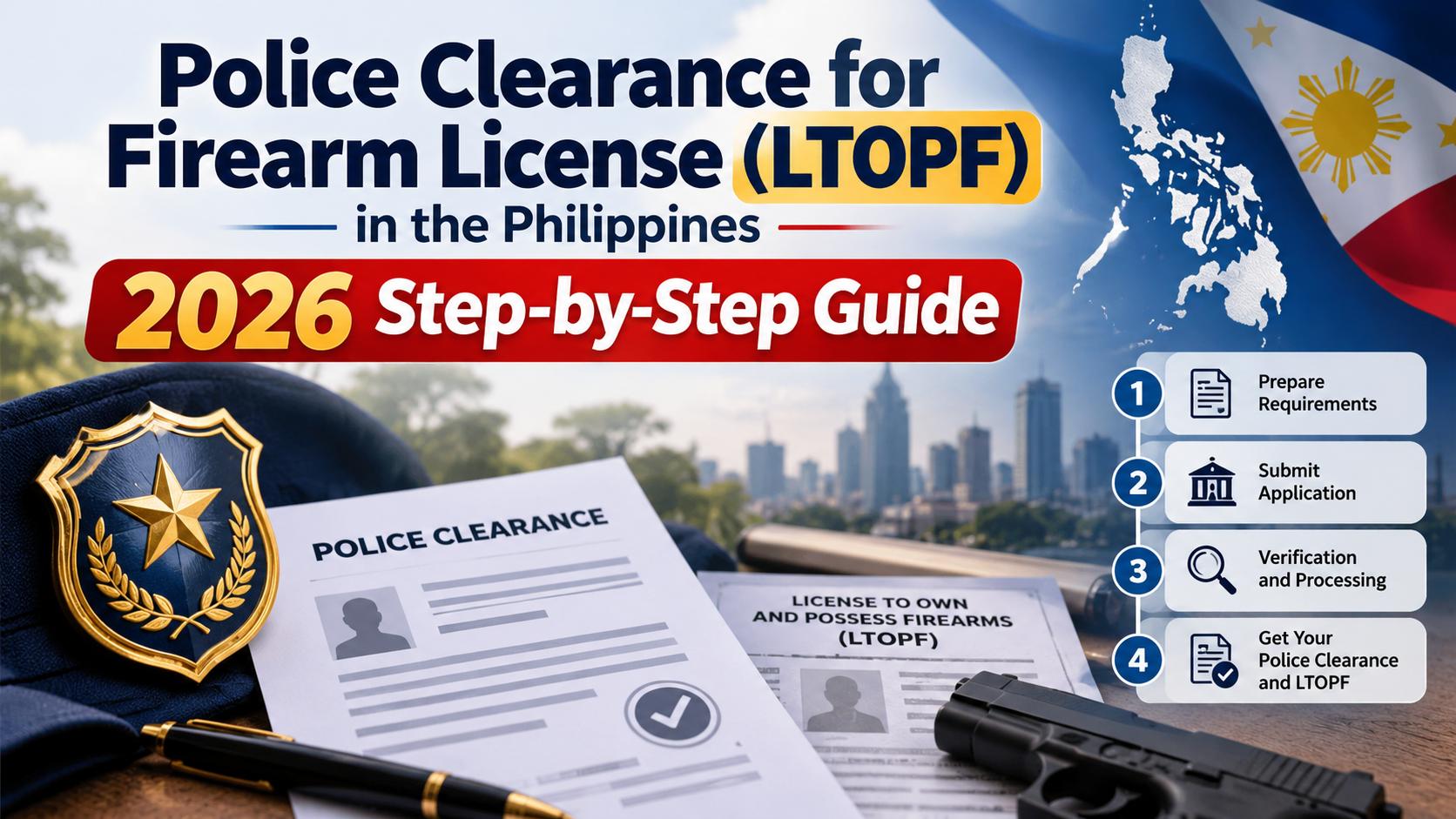
You have passed your gun safety seminar and booked your neuro-psychiatric exam. Then you open the LTOPF checklist and see one line that can quietly delay everything: a valid National Police Clearance.
This guide covers exactly where the police clearance fits in a License to Own and Possess Firearms (LTOPF) application, how to time it, and what changed in the PNP’s rules this month.
Independent information only. This article is not affiliated with the Philippine National Police. Confirm every requirement with the PNP Firearms and Explosives Office before you file.
What Is an LTOPF, and Why Does It Need a Police Clearance?
The License to Own and Possess Firearms (LTOPF) is the permit issued by the Philippine National Police (PNP) that lets a qualified Filipino legally own firearms. It is handled by the PNP Firearms and Explosives Office (FEO) under the Civil Security Group, not by your neighborhood station. The legal basis is Republic Act No. 10591, the Comprehensive Firearms and Ammunition Regulation Act.
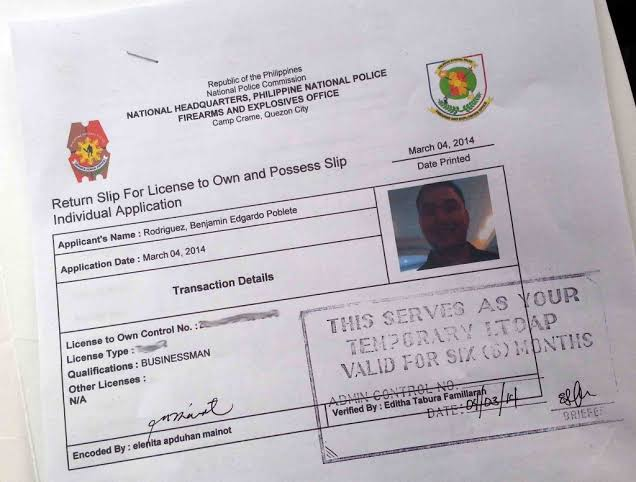
The FEO’s checklist asks for a National Police Clearance Certificate because the licensing office has to confirm you have no pending police record before putting a firearm in your hands. Think of it as one of several “character and fitness” checks, alongside the drug test and neuro-psychiatric evaluation.
Two things people mix up:
- LTOPF lets you own and possess a firearm.
- A permit to carry outside your residence is a separate authorization. Holding an LTOPF alone does not let you carry a gun in public.
Who Can Apply? Basic LTOPF Eligibility
Under RA 10591, applicants generally must:
- Be a Filipino citizen (dual citizens with Filipino citizenship are covered)
- Be at least 21 years old when applying
- Have a gainful occupation, profession or business, backed by an income tax return for the preceding year
What Is on the FEO’s LTOPF Checklist?
The documents listed by the FEO for a new application include:
| Requirement | Practical note |
|---|---|
| Notarized LTOPF application form | Use the latest form revision (see the October 2026 change below) |
| FEO online account | Applications are filed through the FEO website |
| Gun Safety and Responsible Gun Ownership Seminar certificate | Must be PNP-validated |
| PSA birth certificate or unexpired passport | Proof of identity and citizenship |
| Proof of income | ITR, pension certificate or similar |
| One valid ID | Original, unexpired |
| Proof of residency | Billing statement, barangay clearance, etc. |
| National Police Clearance Certificate | The subject of this guide |
| Neuro-psychiatric test | From a PNP-accredited facility, coordinated through your regional unit |
| Drug test | Same as above |
For a longer validity period, the PNP has also listed extras such as a 2×2 photo and an affidavit. Always read the current checklist on the FEO site, because items get added or revised.
New in October 2026: The Gun Vault Photo Rule
If you are applying now, this matters more than any other update. In an October 1 advisory, the PNP-FEO said the Firearms and Explosives Office Form No. 1 and Form No. 2 (Revision – September 2026) must be used for all new and renewal LTOPF transactions starting October 5, 2026.
Applicants must also submit a photo of themselves with their firearm vault or storage container, secured by a lock and key. The safe-storage duty itself is not new, but the photo proof is now part of the filing.
What this means for you: an application built on an older form revision may be sent back. Download the current forms before you pay for anything else.
How to Get the National Police Clearance for Your LTOPF
The National Police Clearance (NPC) is processed through the PNP’s National Police Clearance System, the official portal at pnpclearance.ph. The process is the same whether the clearance is for a job or a gun license, so rather than repeating every screen here, use the dedicated walkthroughs:
- Read the Philippines police clearance requirements so your IDs and personal details match before you register.
- Follow the step-by-step National Police Clearance online registration guide to create your account and book a slot.
- Settle the fee using the GCash police clearance payment guide if you prefer e-wallet payment.
- Attend your appointment for biometrics, then download or print the certificate.
LTOPF-specific tip: write the purpose of the clearance carefully and make sure your name, birth date and suffix are identical to your PSA birth certificate and ID. Your LTOPF file will be cross-checked against these records, so a mismatch can cost you a second clearance.
Timing: When Should You Get the Police Clearance?
This is where most LTOPF applicants lose time. A National Police Clearance is valid for six months, but the full LTOPF file takes weeks to assemble. The safest sequence:
- Start with the slow items: the gun safety seminar, your neuro-psychiatric test and drug test, and your PSA documents.
- Get the police clearance next, early enough to leave room for a “Hit” review.
- File online only when every document is current and uploaded.
Why leave room? If your name matches someone in the database, your clearance is placed on hold for verification. The review can take several working days, and you may be asked for an Affidavit of Denial if you share a common name with a person on record. The Hit and No Hit explainer walks through what the status means and how it resolves.
Can the LTOPF ID Help With Future Clearances?
Yes. The LTOPF ID appears on the list of identification accepted by the National Police Clearance System, which is handy later when you renew your clearance or need another background document. Check the accepted valid IDs list before your appointment, because acceptance can carry conditions.
Police Clearance vs. NBI Clearance for a Gun License
The FEO checklist lists the National Police Clearance, but older articles and some applicants still mention an NBI clearance. Requirements have changed over the years, which is exactly why you should treat the live FEO checklist as the final word.
If you need to understand the difference between the two documents, the Police Clearance vs. NBI Clearance comparison explains what each one searches, and the NBI clearance guide covers that application separately.
LTOPF Types, Validity and Fees at a Glance
How many firearms each type allows
| LTOPF type | Maximum firearms |
|---|---|
| Type 1 | 2 |
| Type 2 | 5 |
| Type 3 | 10 |
| Type 4 | 15 |
| Type 5 | More than 15 (certified collectors) |
Validity: the license and each firearm registration can run for 5 or 10 years, depending on what you choose.
Fees: the PNP’s published schedule, effective March 16, 2024, runs from about ₱1,000 for a Type 1 license over 5 years up to ₱50,000 for a Type 5 over 10 years, plus an ID card fee. Concessions apply to some groups such as government personnel and senior citizens. Fees can change, so confirm the current schedule with the FEO.
Separately, budget for the clearance itself, the medical tests, the seminar, notarization and the vault. Together these often cost more than the license fee for a first-time applicant.
Where and How Do You File the LTOPF?
The FEO accepts applications online through its portal, with walk-in options at Camp Crame and designated PNP offices. The general flow is:
- Create your FEO account.
- Complete and notarize the current application forms.
- Upload scanned documents, including your police clearance and the vault photo.
- Wait for evaluation and approval.
- Pay and upload your proof of payment.
- Register each firearm you buy, because the LTOPF alone does not register a specific gun.
Renewals have a published processing time of roughly 7 to 15 working days when you submit a valid LTOPF and registration form, though real timelines vary.
Common Mistakes That Delay LTOPF Applications
- Letting the clearance expire before the rest of the file is complete
- Name inconsistencies across the clearance, birth certificate and ID
- Using outdated form revisions after the October 5 change
- Skipping the vault photo or sending one without a visible lock
- Paying through unofficial intermediaries that promise “fast” clearance
- Not allowing time for a “Hit” verification
If You Work in Law Enforcement or Security
Some applicants hold or pursue PNP-related roles. These readers often need adjacent documents, so these guides help:
- PNP HPG clearance 2026 for vehicle-related clearance needs
- Fiscal clearance from the prosecutor when a case record needs clarifying
- Barangay certificate requirements for proof-of-residency documents
- NAPOLCOM exam guide for those entering police service
Frequently Asked Questions about Police Clearance for Firearm License (LTOPF)
Final Checklist Before You File
- Current FEO Form No. 1 and No. 2 (Revision – September 2026)
- Photo of you with your locked vault or storage container
- National Police Clearance, still within its six-month window
- Matching name details on every document
- Seminar certificate, medical results, proof of income and residency
Start with the National Police Clearance guide, keep the official PNP clearance portal as your source for transactions, and confirm licensing details at the PNP Firearms and Explosives Office before filing. For how this independent site works, see the disclaimer.
Sources checked: PNP Firearms and Explosives Office licensing page, Philstar and The Chronicle reports on the October 2026 advisory, RA 10591 summaries, and published FEO fee schedule summaries.