
The short answer
For most visas abroad, the Philippine “police certificate” is the NBI Clearance, not the PNP National Police Clearance. Get the PNP clearance only when the checklist names it. Foreigners applying for a Philippine visa usually need a police clearance from their own country, not from the PNP.
That’s the whole decision in three sentences. The rest of this guide shows where each rule comes from, so you can check your own case and avoid paying for the wrong document.
Independent information only. This site is not affiliated with the PNP, the NBI, the Bureau of Immigration or any embassy. Requirements change, so treat the agency or embassy checklist as the final word.
Why “police clearance” causes so much confusion
Here’s a mix-up that happens all the time. Someone applying for a Canadian or US visa sees “police clearance” on a checklist, books a National Police Clearance appointment, pays the fee, and later learns the embassy wanted something else.
The cause is simple. The phrase means different things at different desks:
| What the request says | What it usually means | Who issues it |
|---|---|---|
| “Police certificate” for the Philippines, on a US or Canadian visa checklist | NBI Clearance | National Bureau of Investigation |
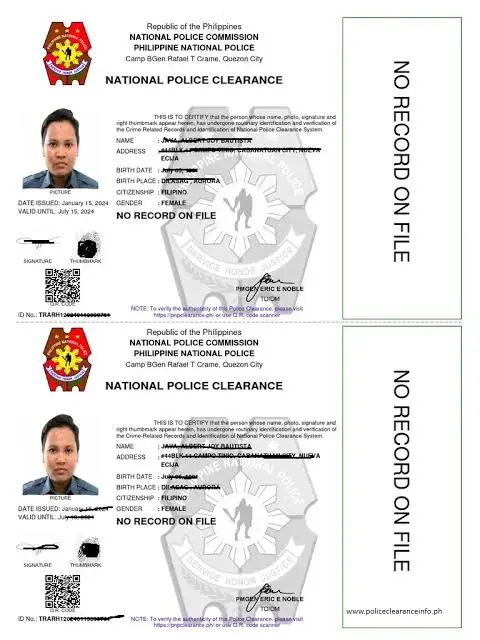
| “PNP National Police Clearance” or “police clearance issued by the PNP” | National Police Clearance | PNP, through NPCS |
| “Police clearance” for a Philippine visa filed by a foreigner abroad | A certificate from the applicant’s home or residence country | That country’s police authority |
| “BI Clearance Certificate” | An immigration-side clearance | Bureau of Immigration |
| “Apostille” on a clearance | Authentication of a Philippine public document for use abroad | Department of Foreign Affairs |
If you want the general differences between the NBI and PNP documents first, the police clearance vs. NBI clearance comparison covers what each one searches, and the NBI clearance guide explains that application separately.
If you’re a Filipino applying for a visa abroad
Start with the country’s own instructions. Two official examples make the pattern clear.
United States. The U.S. Embassy in Manila’s immigrant visa checklist says it requires a Philippine police certificate known as an NBI Clearance, valid for one year from the date it was obtained. It also advises requesting the clearance with an AKA that includes your maiden name, your birth certificate name and any aliases or spellings that appear on your other documents. The embassy recommends asking the NBI to send the clearance directly to it. If you stayed one year or more in another country after turning 16, you need a police certificate from that country too.
Canada. IRCC’s Philippines page names the NBI Multi-purpose Clearance Certificate as the document to submit. No translation is needed because the certificate is in English. If you’re applying from abroad, the NBI mails it instead of handing it over in person. If remarks on the certificate point to a record or a pending case, IRCC asks for a written explanation from the NBI, the full court documents and your own account of what happened. Certifications from clerks of court don’t count.
For other destinations, find the government’s own police-certificate page for the Philippines. Look for the issuing agency’s name, the validity period and any form the country wants you to use. A visa agent’s summary isn’t a substitute.
So when does the PNP clearance matter for a visa?
It matters in a few specific situations:
- The checklist names it. If the wording says “PNP National Police Clearance,” apply through the official portal at pnpclearance.ph. Follow the steps in the police clearance requirements guide so your name and IDs match from the start.
- An employer, agency or school asks for it alongside the visa papers.
- You live abroad and can’t visit a station. The PNP runs a Clearance Certification process for overseas Filipinos and a few special cases. The overseas Filipinos section explains who qualifies and where the official tutorial lives.
- You need to use it in another country. The DFA accepts an original PNP Police Clearance for apostille, as it does for NBI Clearance.
If the wording is vague and you can’t tell, email the embassy or the visa centre before you buy anything. A short reply costs nothing, while the wrong document costs you a fee and a few days.
If you’re a foreigner applying for a Philippine visa
The PNP clearance isn’t the usual document here. The Philippine government screens foreign applicants in two places: at the embassy or consulate abroad, and at the Bureau of Immigration (BI) once the file is in the Philippines.
Filing at a consulate abroad. Philippine consulates generally ask for a police clearance from the applicant’s own country. The Philippine Consulate General in New York, for example, lists a police clearance certificate taken not more than six months before filing for a 13(a) marriage visa. The consulate in Guangzhou asks for a police clearance from the competent Chinese authority, notarized, with the visa application filed within six months of its issue date for a 9(g) work visa. Other posts add apostille or authentication rules, so check the post that handles your file.
Returning natural-born Filipinos. Those applying for a 13(g) visa after naturalizing abroad are asked for both a police clearance from their country of residence and an NBI clearance issued within six months of the visa application, according to the Philippine Embassy in Tokyo.
Already in the Philippines. The BI’s checklist is the one that counts. Its list for work and marriage visas includes a BI Clearance Certificate, and applicants who have been in the country for a while are commonly asked for an NBI Clearance instead of a foreign certificate. Because I couldn’t retrieve the BI’s own current checklist for this guide, confirm the exact rule for your visa type with the BI before you file.
Foreign nationals can also apply for a National Police Clearance if they meet the NPCS eligibility terms. The eligibility section lists the requirement for foreign residents, and the accepted ID list includes the Alien Certificate of Registration.
Validity: how long each document lasts
The clock is where applications quietly fail. A certificate can be genuine and still be too old.
| Document | Validity for this purpose | Source of the rule |
|---|---|---|
| PNP National Police Clearance | 6 months from issue | PNP, through NPCS |
| NBI Clearance for a US immigrant visa | 1 year from issue | U.S. Embassy Manila checklist |
| Police clearance for a 13(a) visa filed in New York | Not more than 6 months before filing | Philippine Consulate General, New York |
| Police clearance for a 9(g) visa filed in Guangzhou | Application filed within 6 months of issue | Philippine Consulate General, Guangzhou |
| NBI Clearance for a 13(g) visa filed in Tokyo | Issued within 6 months of the visa application | Philippine Embassy, Tokyo |
A PNP clearance can’t be extended, but eligible applicants can renew without a new biometric visit within the NPCS window. The renewal without appearance guide shows who qualifies.
A practical way to plan: work backward from your filing date, not forward from today. Start with the slow documents, such as an apostille or a document that needs verification, and get the shortest-lived certificate last.
Using a Philippine clearance abroad: the apostille step
If a foreign government wants a Philippine document, it may also want it apostilled. The DFA’s published requirements list these among the documents it handles:
- NBI Clearance: the original with the dry seal, verifiable online. A personal copy isn’t accepted.
- Police Clearance: the original document issued by the PNP.
- Barangay Clearance or Certificate: a certification from the mayor’s office that has jurisdiction over the barangay.
The DFA also says it takes no responsibility if the receiving country rejects an apostilled document, and that countries outside the Apostille Convention may require legalization at their own embassy. So check that your destination accepts a Philippine apostille before you queue. For a barangay paper you may need to support an application, the barangay certificate requirements are covered in their own guide.
What if your clearance shows a “Hit”?
A “Hit” means your name matched a record. It doesn’t always mean the record is yours. Common names trigger it constantly.
On the PNP side, the clearance is held for verification, and you may be asked for an Affidavit of Denial if you’re a namesake. The Hit vs. No Hit explainer walks through the stages. If a case was filed and later dismissed, a fiscal clearance from the prosecutor can help show how it ended.
For visas, build in extra time. Embassies don’t speed up because your verification is pending.
A 30-day plan that avoids the usual delays
- Day 1: Read the exact wording on your checklist. Write down the document name, the issuing agency and the validity limit.
- Day 1 to 3: Check your civil documents for spelling. Your name should read the same on your passport, birth certificate and IDs.
- Day 3 to 7: Apply for the document the checklist actually names. Use the official portal only. For a PNP clearance, the step-by-step registration guide and the GCash payment walkthrough cover the portal and payment.
- Day 7 to 20: Allow for verification, mailing or an apostille appointment.
- Day 20 to 30: Confirm each certificate is still inside its validity window on your filing date, then submit.
- Before you hand it over: Verify it. The verification guide shows how to check a PNP certificate online.
Mistakes that cost people money
- Buying the PNP clearance when the embassy wanted the NBI. Read the checklist wording first.
- Using a certificate that expired before filing. Count from the issue date.
- Name mismatches. PNP says it won’t reprint a certificate because you entered wrong details, and locked account fields can’t be edited. The correction guide explains what to do.
- Leaving out aliases. The US Embassy’s AKA advice exists for a reason.
- Sending a photocopy where the original is required, such as for an apostille.
- Trusting a middleman. Use official portals and embassy channels.
Frequently asked questions
Where to go next
If you’re building a full document set, these guides pair well with this one: the National Police Clearance overview, the requirements checklist, the visa and immigration section and the site disclaimer.
Sources and references
Checked in October 2026. Agencies update their rules, so confirm before you file.
- NBI Clearance online system (clearance.nbi.gov.ph)
- PNP National Police Clearance System (pnpclearance.ph)
This guide is general information, not legal or immigration advice.