
You’ve sent your resume, completed the interview, and received encouraging news from the company. Then HR sends you a list of documents to submit before your first day. Along with your government IDs and other employment records, there’s a request for police clearance.
For many Filipino jobseekers, this is when the questions begin. Is police clearance necessary for every job? Will an existing certificate be accepted? And if you already have an NBI clearance, do you still need another document?
The answer depends partly on the employer and the position you’re applying for. Here’s what you should know before spending money or taking time away from your job search.
Why Do Employers Ask for Police Clearance?
Employers may request police clearance as part of their pre-employment background checks. It helps them review information about an applicant’s criminal record using the records available to the Philippine National Police (PNP).
A police clearance is not a recommendation letter or a guarantee that someone will be a good employee. It is an official document used for a particular type of background verification.
For employers, it can be one part of assessing an applicant’s suitability for a role. Other checks might include verifying previous employment, contacting references, or confirming professional qualifications.
This is particularly relevant for positions involving money, sensitive records, company property, or responsibilities where trust and accountability are important.
However, not every employer uses the same hiring process. Some companies request police clearance only after offering a job, while others identify it among their pre-employment requirements earlier in recruitment.
If a job advertisement doesn’t mention police clearance, don’t assume you need to obtain one immediately. Ask the employer which documents will be required and when they must be submitted.
Related – PNP Payslip
Is Police Clearance Mandatory for Every Job in the Philippines?
There is no single rule making a National Police Clearance a universal requirement for every private-sector job application in the Philippines.
An employer may include it in the company’s hiring policy, while another employer may rely on a different set of documents.
For example, an office employer may request police clearance before a new employee starts work. A business recruiting temporary staff might use a shorter document checklist. Positions subject to specific government or industry requirements may involve additional checks.
The important distinction is between a document required by law for a particular position and a document requested under an employer’s recruitment policy.
Before applying for clearance, confirm the following with HR:
- Does the company require a National Police Clearance or a Local Police Clearance?
- Is an NBI Clearance also necessary?
- Must the document be submitted before the final interview or after receiving a job offer?
- How recently must the clearance have been issued?
- Will the company accept a digital copy initially, or is the original required?
These questions can save you from securing the wrong document or having to apply again.
When Should You Get Police Clearance During the Hiring Process?
One mistake jobseekers sometimes make is obtaining all their employment documents before they have even started applying for positions.
Being prepared is useful, but police clearance has a limited validity period. Getting it too early can mean that the certificate is close to expiring by the time an employer requests it.
A practical approach is to prepare your IDs and other documents first, then arrange the clearance when the employer confirms that it is needed.
Before Sending Your Resume
At this stage, most applicants are concentrating on their CV, cover letter, employment history, and qualifications.
Unless the vacancy specifically asks for police clearance during initial submission, you may not need to obtain one yet.
After the Interview
Once you become a serious candidate, HR may explain the company’s background-check and documentation requirements.
This is a good time to ask which clearance is accepted and the deadline for submission.
After Receiving a Job Offer
Many employers collect pre-employment documents after making a conditional offer.
If police clearance is included, arrange to obtain it before the employer’s deadline. Remember that some applications can take longer when additional verification is necessary.
Before Your First Working Day
Some companies require the complete document checklist before onboarding. Others may permit certain outstanding documents to follow, subject to company policy.
If your clearance is still being processed, inform HR rather than assuming the deadline can be extended.
National Police Clearance or NBI Clearance: Which One Does HR Need?
Although people sometimes use the terms interchangeably, National Police Clearance and NBI Clearance are different documents issued by different government agencies.
A National Police Clearance is issued through the Philippine National Police. An NBI Clearance is issued through the National Bureau of Investigation.
Both may be used for background-check purposes, but one should not automatically be treated as a substitute for the other.
| Document | Issuing agency | What jobseekers should know |
|---|---|---|
| National Police Clearance | Philippine National Police | Used for police-record checks through the PNP system |
| NBI Clearance | National Bureau of Investigation | A separate background-clearance document |
| Barangay Clearance | Barangay authorities | May be requested for local documentation or employment purposes |
If HR asks specifically for an NBI Clearance, submitting a police clearance instead may leave your requirements incomplete.
Likewise, if the employer lists both documents, ask whether both are mandatory. Obtaining one does not automatically satisfy a request for two.
Can First-Time Jobseekers Get Police Clearance for Free?
Yes. Qualified first-time jobseekers in the Philippines may benefit from Republic Act No. 11261, also known as the First Time Jobseekers Assistance Act.
The law was approved on April 10, 2019, to reduce the cost of obtaining government documents needed for employment.
Police clearance certificates are specifically included among the covered documents.
The law also covers several other pre-employment requirements, including NBI Clearance, Barangay Clearance, certain civil registry documents, and other eligible government-issued employment records.
Who Can Claim the Fee Waiver?
The benefit is intended for individuals who meet the legal requirements for first-time jobseeker status.
To claim the benefit, an eligible applicant must present a barangay certification confirming that they are a first-time jobseeker.
The privilege is subject to the law’s conditions and can be availed of only once.
It is not a permanent exemption from police clearance fees whenever a person changes jobs.
How to Request the First-Time Jobseeker Benefit?
1. Visit your barangay office.
Ask about obtaining a First-Time Jobseeker Certification under Republic Act No. 11261.
2. Prepare the required identification.
Your barangay may ask for supporting documents to establish your identity and eligibility. Confirm its requirements before visiting.
3. Obtain your certification.
Make sure the document identifies you as a first-time jobseeker.
4. Ask the police clearance issuing office about the exemption procedure.
Explain that you intend to claim the benefit under RA 11261. Confirm how the exemption is handled before completing any payment through the online system.
5. Follow the official application instructions.
Present the required certification and other documents in accordance with the issuing office’s procedure.
The law establishes the right to the applicable government fee waiver, but you should confirm the current processing arrangements with the PNP. Do not assume the online payment page automatically identifies first-time jobseekers.
If you need help obtaining pre-employment documents, you can also contact your local Public Employment Service Office (PESO).
What Documents Should You Prepare for Employment?
Police clearance is often one item on a longer checklist. Preparing the documents together can make onboarding easier, but the exact requirements depend on the employer.
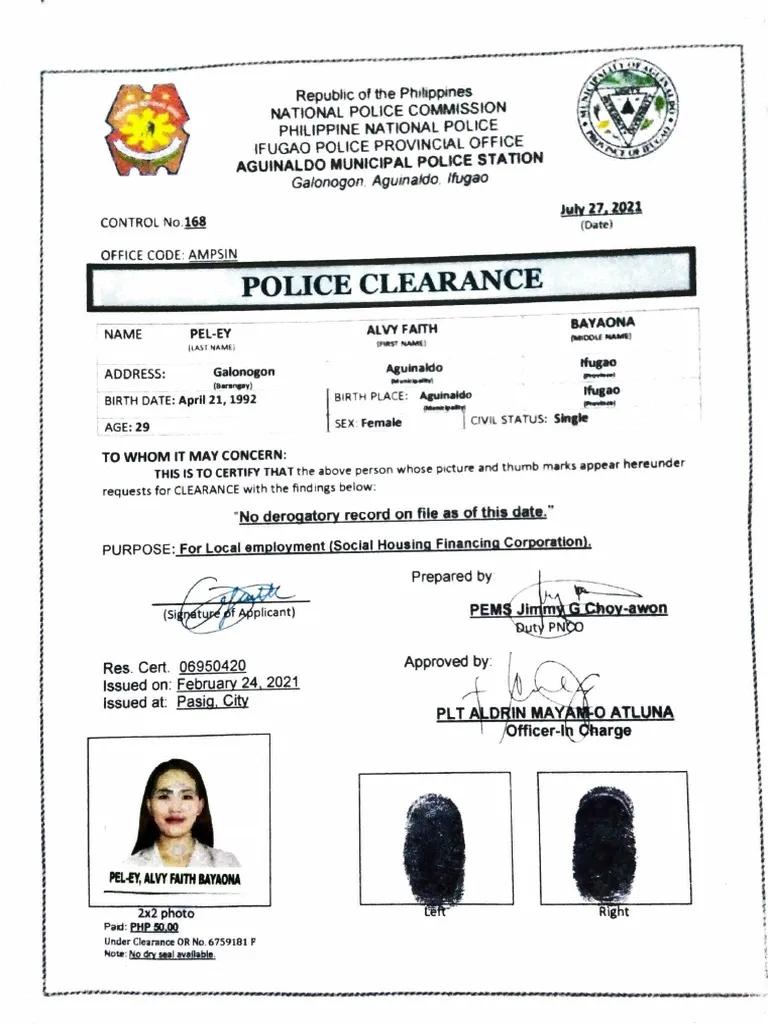
Commonly requested pre-employment records may include:
- A valid government-issued ID.
- Police Clearance or NBI Clearance, depending on HR instructions.
- Philippine Statistics Authority (PSA) Birth Certificate.
- SSS, PhilHealth, and Pag-IBIG membership information, where applicable.
- Tax Identification Number (TIN).
- Educational records or professional credentials.
- Medical certificate or other position-specific health documents, if required.
You might not need every item on this list. Your employer should identify which documents are necessary for the position.
It’s also worth checking whether HR needs the original, a photocopy, or an electronic copy. Sending the wrong format can delay the completion of your file even if you have the correct document.
Can You Use an Old Police Clearance for a New Job?
Possibly, but check the date.
A National Police Clearance issued by the PNP is valid for six months. An employer may also set its own requirement regarding how recently the certificate must have been issued.
For example, you might have a clearance that is still within its official six-month validity period, while the hiring company requests a more recently issued document.
In that situation, ask HR whether your existing certificate is acceptable before applying for a new one.
If your clearance has already expired, you should not submit it as though it were current.
Applicants who previously completed an in-person National Police Clearance application within the last three years may also be eligible for the NPCS Non-Appearance application process. This is separate from the certificate’s six-month validity period.
What if Your Police Clearance Is Delayed?
A delay can be stressful when your employer is waiting for the document, especially when the start date is approaching.
Sometimes, additional verification is needed before the application can be completed. The appropriate next steps depend on the issue and the instructions given by the issuing office.
If you’re experiencing a delay:
- Inform HR early. Explain that your clearance is still being processed and provide the expected submission date only if the issuing office has confirmed one.
- Keep your transaction information. Save the reference number, appointment confirmation, and relevant official receipts.
- Follow up through official channels. Contact the issuing police station or NPCS helpdesk when clarification is needed.
- Ask whether temporary proof is acceptable. Some employers may consider a transaction acknowledgment while waiting for the final certificate. This is entirely subject to employer approval.
Avoid modifying a clearance document or presenting an application receipt as though it were the issued certificate.
What if the Employer Rejects Your Police Clearance?
Rejection doesn’t always mean that there is a problem with your background. Sometimes, the issue is administrative.
Common reasons an HR department may decline a document include:
The Clearance Has Expired
Check the issuance and expiration dates. If the document is no longer valid, you may need a new one.
The Employer Requested a Different Clearance
An NBI Clearance, Local Police Clearance, and National Police Clearance are not necessarily interchangeable.
Ask HR to specify which document is required.
Your Name Doesn’t Match Your Other Records
Differences in spelling, middle names, or surname information can create questions during document verification.
Check that your clearance details match your identification and employment records. If a correction is required, follow the official NPCS procedure.
The Company Requires a More Recent Certificate
Some employers establish their own recency standards for hiring documents.
If the requirement wasn’t clear, ask HR to confirm the accepted issuance-date range.
HR Cannot Verify the Document
The PNP provides an online clearance verification service. Employers or certificate holders can use the official portal to check the clearance using the required information.
If the record cannot be verified, contact the appropriate issuing authority instead of repeatedly submitting the same document.
Can Police Clearance Be Used for Both Private and Government Jobs?
A National Police Clearance may be requested as part of recruitment for private companies or government positions.
However, acceptance is determined by the requirements of the hiring office.
Private employers may have their own background-check policies. Government recruitment may involve additional eligibility documents, examinations, certifications, or agency-specific screening.
If you’re applying for a government position, read the official vacancy notice carefully. Do not assume that a National Police Clearance alone satisfies every background-check requirement.
For any job, the safest approach is to prepare the exact documents listed in the recruitment instructions rather than relying on a general pre-employment checklist.
Does Having a Police Record Automatically Disqualify You From Employment?
Not necessarily.
A police clearance is one source of information that an employer may consider. The effect of a record on a particular job application can depend on the nature and status of the record, the requirements of the position, and applicable law.
A criminal allegation, a pending case, and a conviction are not identical.
If the clearance raises an issue, do not assume the outcome of your job application. Seek clarification from the issuing authority and, where necessary, qualified legal advice.
Applicants should also avoid providing false information when an employer asks lawful questions about their background.
How Can Employers Verify a Police Clearance?
Employers seeking to confirm a National Police Clearance can use the verification facility provided by the PNP.
The official National Police Clearance System includes a Clearance Verification section that requests the applicant’s surname and clearance transaction number.
Verification should be performed through https://pnpclearance.ph/.
Because a clearance contains personal information, applicants should submit it only to legitimate employers through appropriate recruitment channels.
Avoid posting a photograph of your clearance publicly or sharing its transaction details in online job-seeking groups.
Frequently Asked Questions:
Do I need police clearance before applying for my first job?
Not necessarily. Some employers request it only after an interview or job offer. Check the vacancy instructions before obtaining one.
Is police clearance required for a private company?
It depends on the employer’s recruitment policy and the position. Not every private company has the same requirements.
Can I submit NBI Clearance instead of Police Clearance?
Only if the employer accepts it. These documents come from different agencies, so confirm the exact requirement with HR.
Can I get free police clearance for my first job?
Qualified first-time jobseekers may claim the applicable fee exemption under Republic Act No. 11261 by presenting a barangay certification and following the issuing office’s procedure.
Can I use the same police clearance when applying to several companies?
A valid clearance may be presented to different employers, subject to each company’s document requirements and policies. Confirm whether each employer needs an original or will accept a copy.
What if my police clearance expires before I get hired?
Ask the employer whether a newly issued clearance is required. If it is, you will need to obtain a current document through the official procedure.
Can I apply for a job while my clearance is still pending?
Yes, you can generally continue applying for jobs, but whether a particular employer will proceed with hiring or onboarding before receiving the clearance depends on its requirements.
Final Thoughts
Police clearance is an important pre-employment document for many Filipino jobseekers, but it is not something you should obtain blindly for every vacancy.
Start by checking what the employer actually needs. Confirm whether National Police Clearance, NBI Clearance, or both are required, and find out when the documents must be submitted.
If you’re applying for your first job, ask about the First Time Jobseekers Assistance Act before paying any applicable government fees. The exemption can help reduce the cost of preparing for employment.
For registration, verification, and official National Police Clearance services, use the Philippine National Police’s website at https://pnpclearance.ph/.
For detailed online application instructions, see our main National Police Clearance guide.
Official References
- Philippine National Police — National Police Clearance System: https://pnpclearance.ph/
- Republic Act No. 11261 — First Time Jobseekers Assistance Act: https://elibrary.judiciary.gov.ph/thebookshelf/showdocs/2/87437
- Department of Labor and Employment — Assistance to First Time Jobseekers: https://ble.dole.gov.ph/ftjaa/