
Filing Fees for Civil Cases: Understanding filing fees is one of the most overlooked—but crucial—parts of initiating a civil case in the Philippines. Whether you’re filing a complaint, petition, or appeal, knowing the exact costs can save you from delays and surprises.
Let’s break it down in simple terms.
How Much Are Filing Fees for Civil Cases in the Philippines?
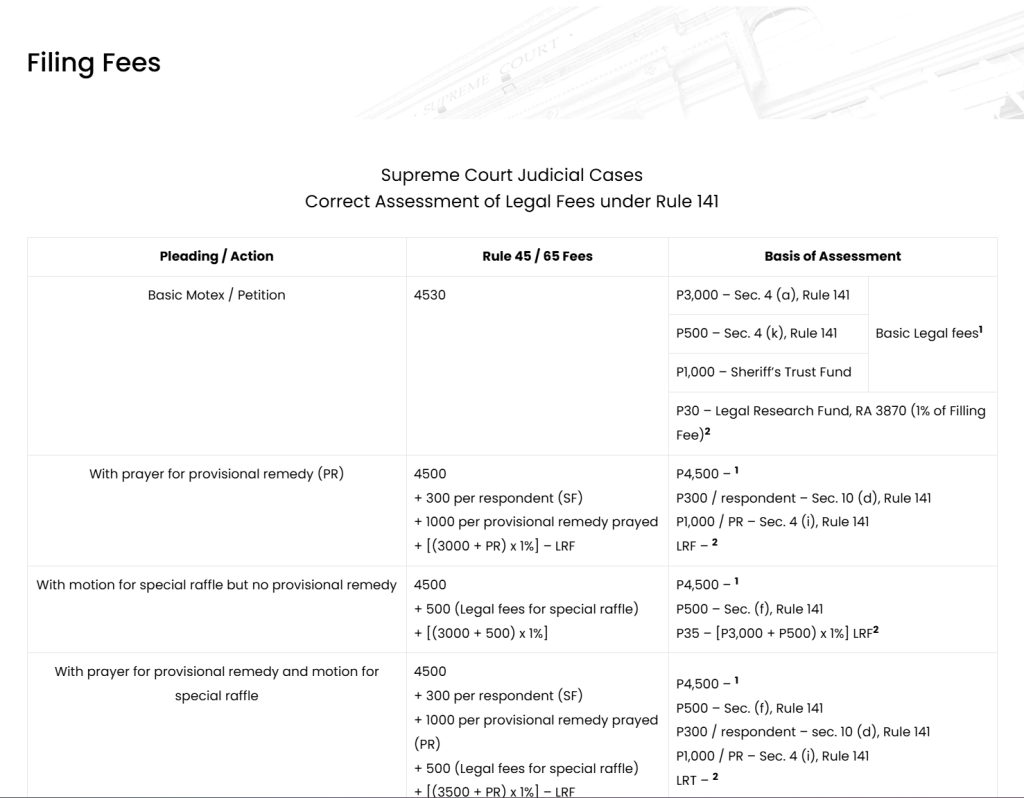
Filing fees vary depending on the type of case and court level. For civil cases, the fees are generally based on:
- The value of the claim (for money/property cases)
- The nature of the action (ordinary civil action vs. special civil action)
- The court where the case is filed (MTC, RTC, CA, or Supreme Court)
For example:
- Lower courts (MTC): Lower filing fees
- Regional Trial Courts (RTC): Moderate fees
- Supreme Court petitions: Around ₱4,500 base fee
Filing Fees for Civil Case Philippines Based on Claim Amount
In ordinary civil cases (like collection of money or damages), filing fees are computed based on the total claim value:
- The higher the claim → the higher the filing fee
- Includes:
- Docket fees
- Legal Research Fund (~1%)
- Other court charges
👉 Example:
If you’re claiming ₱1,000,000, your filing fee will be significantly higher than a ₱100,000 claim.
Supreme Court Filing Fees for Rule 45 and Rule 65 Petitions Philippines
If you’re elevating a case to the Supreme Court:
- Base Filing Fee: ~₱4,500
- Additional costs:
- ₱300 per respondent
- ₱1,000 per provisional remedy (like TRO)
- ₱500 for special raffle (urgent handling)
💡 The Legal Research Fund (LRF) is added at 1% of certain fees, not the entire total.
Additional Costs for Provisional Remedies and Urgent Motions Philippines
If your case includes urgent relief, expect added fees:
- Temporary Restraining Order (TRO) → +₱1,000
- Preliminary Injunction → +₱1,000
- Special Raffle Request → +₱500
These fees reflect the urgency and additional court resources required.
How Filing Fees Increase with Multiple Respondents Philippines
Each additional respondent adds cost:
- ₱300 per respondent (Sheriff’s Fund)
👉 So if you file against 5 respondents:
- Additional ₱1,500 on top of base fees
Legal Research Fund Philippines Explained (1% Rule)
The Legal Research Fund (LRF):
- Equivalent to 1% of filing-related fees
- Used to support legal research and judiciary improvements
- Mandatory in all filings
Sample Computation of Filing Fees Civil Case Philippines
Let’s simplify a scenario:
Case: Petition with:
- 2 respondents
- 1 provisional remedy
- No special raffle
Computation:
- Base fee: ₱4,500
- Respondents: ₱600
- Provisional remedy: ₱1,000
- LRF (~1%): ~₱50–₱60
Estimated total: ~₱6,100+
Tips to Estimate Filing Fees Before Filing a Civil Case Philippines
- Always identify:
- Type of case
- Number of parties involved
- Whether urgent relief is needed
- Ask the court clerk for an official assessment
- Use a filing fee calculator when available
Common Mistakes When Paying Filing Fees in Civil Cases Philippines
- Underpaying fees → case may be dismissed
- Forgetting additional respondent costs
- Ignoring LRF computation
- Not including fees for motions/remedies
Final Thoughts –
Filing fees in the Philippines are structured but can become complex depending on your case. The key is understanding that:
- Base fees are fixed
- Extras depend on complexity
- Accuracy matters—mistakes can delay your case
If you’re unsure, always consult a lawyer or the court’s assessment office before filing.